Ophthalmic examination
Indication/history
Recorded eyelid findings and first signs
Provision to examine
Exam-fee benefit and condition eligibility
Evidence question
Is examination reimbursement selected?

Review the eyelid diagnosis, first signs and itemized surgical estimate together.
Use these checkpoints to frame the literal question before reading the full guide.
Pet insurance may cover entropion surgery when the condition and related treatment satisfy the applicable policy, but the procedure name alone cannot establish payment. Check the first signs, waiting-period timing, any congenital or hereditary wording, and the eligibility of the examination, correction, anesthesia and rechecks. A later surgical date does not erase an earlier eye problem.
The sections below show how to verify the answer and what can change it.
ACVO describes entropion as inward rolling of an eyelid, with several possible causes. Young animals may receive temporary eyelid tacking; definitive surgical correction is a separate treatment decision. Keep the ophthalmologist’s diagnosis and proposed procedure intact rather than treating every eye operation as the same service.
An estimate for entropion should not be used as evidence about surgery on the third-eyelid gland, often called cherry-eye surgery. If the veterinarian proposes more than one procedure, obtain separate descriptions and charges where possible. The purpose is to make the insurance question precise, not to choose the operation or delay treatment.
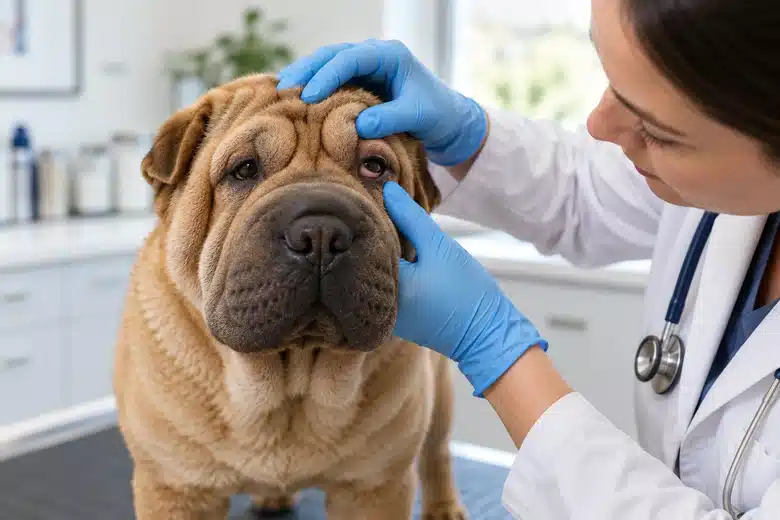
| Invoice item | Indication/history | Provision to examine | Evidence question |
|---|---|---|---|
| Ophthalmic examination | Recorded eyelid findings and first signs | Exam-fee benefit and condition eligibility | Is examination reimbursement selected? |
| Temporary tacking | Reason temporary approach is proposed | Treatment definition and eligible condition | How is this distinct episode classified? |
| Definitive eyelid correction | Diagnosis, affected lid and side | Surgical benefit; hereditary/congenital exclusions | Does any applicable exclusion reach this diagnosis? |
| Anesthesia and monitoring | Linked to the named procedure | Eligible associated treatment | Are these costs itemized and included? |
| Recheck or further correction | Clinical reason and dates | Follow-up and exam provisions | Does a separate cap or selection apply? |
| Opposite eye | Its own findings and timeline | Any bilateral or related-condition wording | Is an exclusion actually present, and what does it say? |
Record the owner’s first observation, first veterinary examination, diagnosis, policy effective date, applicable waiting-period end and proposed surgery date. A note of squinting is an observation; whether it is related to entropion is a clinical and policy-evidence question. Do not rename or omit earlier symptoms to make the chronology look more favorable. If the record is genuinely unclear, ask for an accurate clarification.
As one policy example, section 5.A.1 of the Pets Best IAIC-PB10001-ILL specimen addresses earlier advice, treatment or verifiable related signs in its prior-condition exclusion. This Alabama-labeled specimen does not decide a particular pet’s entropion claim or establish current terms everywhere.
Keep policy terms, deductible, reimbursement and limits beside the quote so the comparison stays consistent.
Keep three issues separate: what caused the eyelid problem, when the signs existed, and what the offered contract excludes or covers. A clinical label should not be converted automatically into either “covered” or “excluded.” Read any congenital or hereditary clause alongside the general coverage grant and prior-condition definition. Likewise, do not assume the second eye will be excluded simply because the first was affected; locate any actual bilateral language and compare the documented facts.
For an invented $2,400 total bill, suppose $2,000 is eligible, the unmet deductible is $400, and the fictional policy pays 80% after the deductible with enough remaining limit. Payment would be $1,280, leaving $1,120 of the invoice to the owner. Every number and term in this example is hypothetical. A real estimate may contain different services and a real policy may calculate reimbursement in another order.
ACVO notes that untreated entropion can damage the cornea. Seek prompt veterinary advice for a painful or abnormal eye rather than waiting for insurance research. No claim approval or individualized clinical advice is given here.
No. Earlier signs and the applicable timing and exclusions still matter.
No. Keep eyelid correction distinct from a third-eyelid gland procedure and use the veterinarian’s exact description.
Keep the policy terms beside the price, then continue to rates when the comparison is clear.